Southern Hospitality and cookies. This site uses cookies to personalise your experience, analyse site traffic and keep track of items stored in your shopping basket. By clicking ACCEPT or continuing to browse the site you are agreeing to our use of cookies. See our Privacy Policy here. Learn more

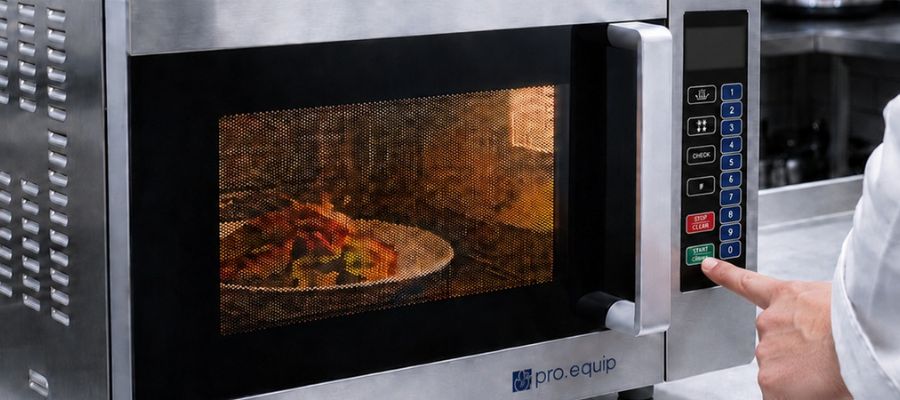
Power Your Kitchen with the Right Commercial Microwave
June 2026
In fast-moving hospitality environments across New Zealand, benchtop equipment plays a big role in keeping service consistent. One of the most important pieces is the commercial microwave oven, used for reheating, defrosting, and preparing food quickly.
Unlike household appliances, commercial microwave ovens are designed for continuous operation, higher output, and the daily pressures of professional kitchens. Pro.equip offers a dependable range of benchtop solutions built for ease of use and long-term performance. When chosen and integrated well, a commercial microwave can speed up service, improve consistency, and streamline kitchen workflows.
What Sets a Commercial Microwave Apart?
Commercial microwave ovens are purpose-built for hospitality venues. They deliver the durability and performance needed to handle the demands of constant use.
Commercial models are designed to operate continuously during service, unlike domestic units that are suitable for occasional heating. They feature strong construction and higher wattage levels, ensuring consistent results. Programmable settings also allow staff to recreate dishes with accuracy, even during busy periods.
These microwaves are designed to endure frequent door use, varied portion sizes, and back-to-back cooking cycles. As part of a wider commercial cooking equipment setup, the microwave supports both preparation and service tasks. Microwaves usually heat food more quickly than other benchtop appliances. They work alongside ovens, grills, and fryers to improve workflow, reduce delays, and maintain speed during peak times.
How Microwave Technology Heats Food
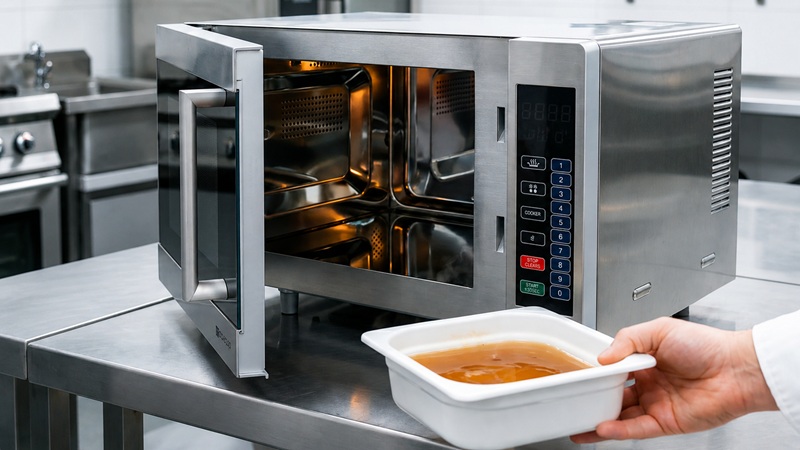
Understanding how a microwave oven functions highlights why it is so efficient in professional kitchens. The appliance uses electromagnetic waves to activate water molecules within food.
As these molecules move rapidly, heat is produced internally, allowing food to cook or reheat evenly in a short time. This process makes microwaves highly effective for defrosting, reheating, and finishing dishes.
In a commercial kitchen, this efficiency helps maintain output during busy service periods, reduces customer wait times, and keeps operations running smoothly.
Types of Commercial Microwave Ovens
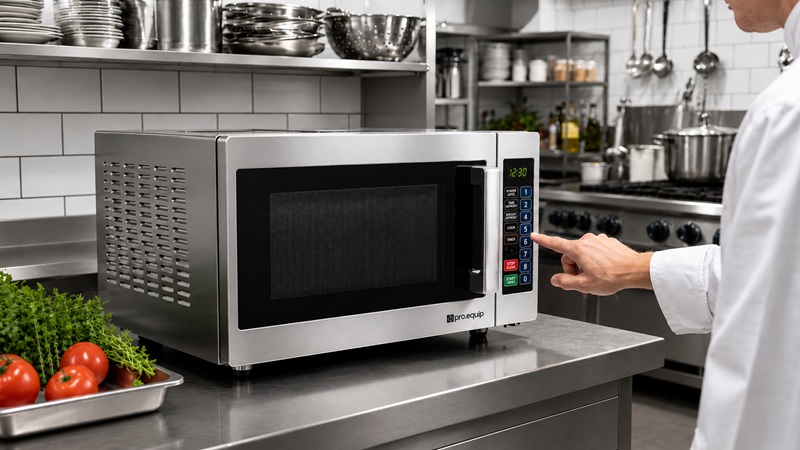
Selecting the right microwave starts with knowing how each type fits your kitchen needs. Different formats offer varying levels of versatility depending on the menu and service style.
Standard Commercial Microwave
A standard commercial microwave is built for reliability and everyday use. It performs essential tasks such as reheating, defrosting, and finishing dishes with speed.
These models are ideal for frequent operation and provide consistent results through simple controls, making them suitable for most hospitality settings.
Convection Microwave
A convection microwave blends traditional microwave heating with convection cooking. This allows food to be heated while still achieving browning or crisping in one unit.
For New Zealand venues where space is limited, this type of microwave provides flexibility without needing additional equipment. It is especially useful for:
- Light baking tasks
- Finishing dishes with texture
- Expanding menu options within a compact setup
Combi Oven
Although not strictly a microwave, a combi oven plays a related role in food preparation. A commercial combi oven unit combines steam, convection, and sometimes microwave functionality.
These appliances are larger and more complex, often requiring a higher investment. They are best suited to kitchens needing precision cooking and menu versatility.
Compared to microwaves, combi ovens:
- Offer greater control over cooking conditions
- Support a wider variety of techniques
- Suit high-end or large-scale operations
However, for speed and simplicity, microwaves remain the preferred option.
Commercial Microwaves vs Traditional Ovens
Understanding the difference between a commercial microwave oven and a traditional commercial oven is essential for designing an efficient kitchen. A microwave is focused on speed. It excels at reheating, defrosting, and finishing dishes quickly, making it invaluable during busy service periods. Its compact size also makes it ideal for benchtop use. In contrast, a commercial oven is designed for primary cooking tasks such as roasting, baking, and grilling. It delivers controlled, even heat over longer periods and is central to more complex menus. Ventilation is another key factor. Most commercial ovens require proper extraction systems to manage heat and grease, which can increase installation costs and space requirements.
Key Considerations When Choosing a Commercial Microwave
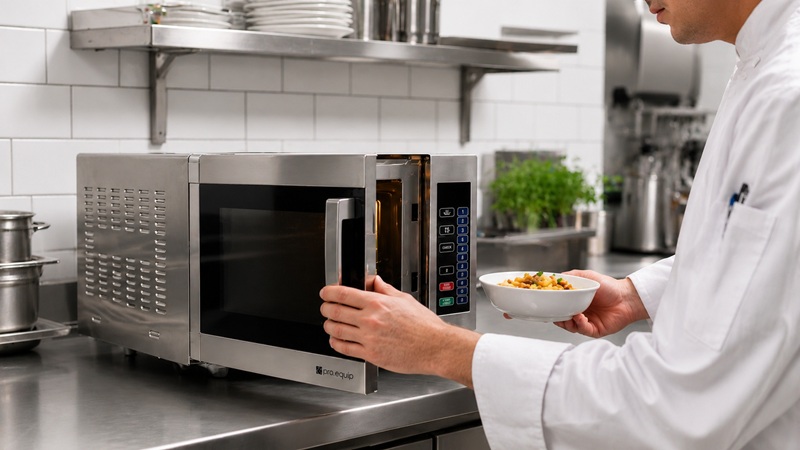
Choosing the right microwave depends on your daily kitchen operations. The following factors will help you make an informed decision.
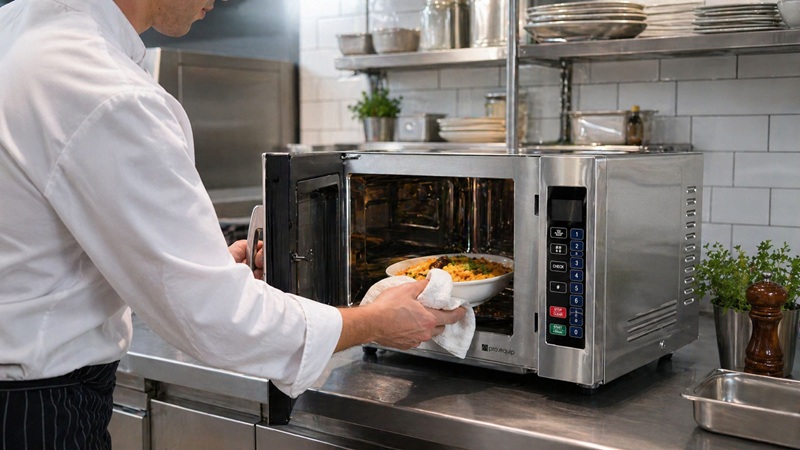
Power and Output
Wattage determines how quickly and efficiently food is heated.
- 1000W–1200W: Suitable for cafés, smaller kitchens, or light-duty use
- 1200W and above: Ideal for high-volume venues, pubs, and quick-service operations
Capacity and Space Fit
The size of the unit should match both your menu needs and available workspace.
Consider:
- Plate and container sizes
- Usage frequency during service
- Available bench space
Compact models like the Pro.equip 25L microwave oven are well suited to kitchens where space is limited but performance is still essential.
Build Quality and Durability
Commercial kitchens require equipment that can withstand constant use.
Look for:
- Stainless steel interiors and exteriors
- Reinforced doors and hinges
- Heavy-duty components for long-term reliability
Ease of Operation
Simple controls are essential in fast-paced environments.
Features to prioritise include:
- Dial or programmable settings
- Clear interfaces
- Minimal staff training requirements
Cleaning and Maintenance
Maintaining hygiene is critical in any hospitality setting.
An ideal unit should:
- Be easy to wipe down
- Have minimal seams or crevices
- Allow quick cleaning between service periods
Best Practices for Using a Commercial Microwave
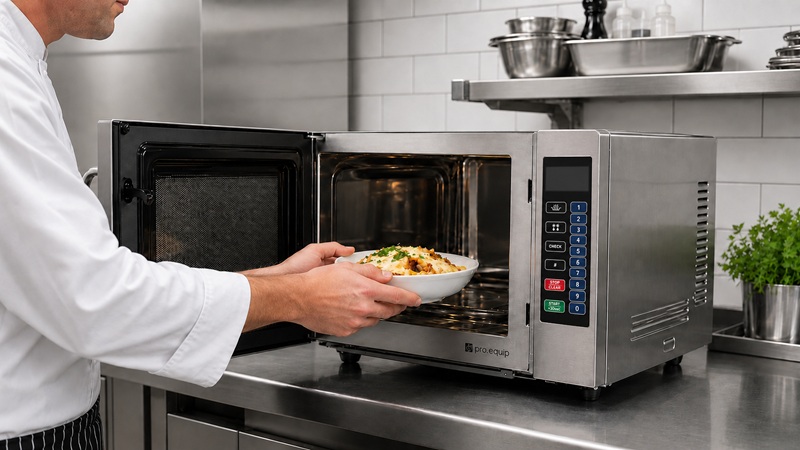
Using a commercial microwave effectively involves more than pressing start. Correct usage ensures consistent food quality and efficient service.
- Use preset programmes for repeat menu items
- Adjust power levels based on the food type
- Avoid running delicate food at maximum power.
- Only use microwave-safe materials such as approved plastics, glass, or ceramics.
- Position food centrally and distribute evenly
- Heat in shorter intervals and adjust as needed
- Use programmed settings for high-volume items where possible
Frequently Asked Questions
How do you cook rice in a microwave cooker?
Add one cup of rice and two cups of water to a microwave-safe container. Cook on high for 10–12 minutes, then let it rest for five minutes before fluffing. For commercial use, avoid overfilling and cook in batches.
How can you make poached eggs in a microwave?
Place an egg in a cup of water, gently pierce the yolk, cover, and cook for 45–60 seconds. Let it sit briefly before serving.
What’s the best way to clean a microwave?
Wipe the interior regularly to prevent build-up. For deeper cleaning, heat water with lemon for a few minutes, then wipe the surfaces clean.
How do you melt chocolate in a microwave?
Heat chopped chocolate in 20–30 second intervals, stirring between each cycle. Use medium power to prevent burning.
How do you cook corn on the cob in a microwave?
Place corn (with husk or wrapped in a damp paper towel) inside and cook for 3–5 minutes. Let it rest briefly before serving.
Is it safe to use plastic in a microwave?
Only use containers labelled as microwave-safe. Avoid single-use plastics or containers not designed for heat.
Choosing the right commercial microwave oven for your New Zealand kitchen can significantly improve efficiency, food quality, and service speed. With reliable options like Pro.equip and the right supporting equipment, you can create a streamlined and productive kitchen environment.
Recent Posts